
TLDR:
-> Tendons are a viscoelastic transitional tissue that connect highly elastic muscle tissue to highly stiff bone tissue.
-> Sport-related injuries very commonly occur at tendon junctions.
-> Tendons require long exposures to slow/heavy mechanical tension to drive positive adaptations important for sport performance and injury resilience.
-> Sports typically consist of short/fast muscular contractions that not only fail to fully develop tendon strength but also consist of force profiles that increase injury risk.
-> Strength training protocols that target tendon health simultaneously increase sport performance while protecting against the damaging nature of most sports.
-> Tendons require both off-season and in-season periodized strength training programs to ensure their health.
- - - - -
Tendons are the connective tissue that connect muscles to bones. While accurate, that common, oversimplified perspective disregards a more complex nature that needs to be acknowledged if our goal is to create healthy, resilient, high-performance tendons. Tendons are a unique intermediary tissue that transition between the highly elastic properties of muscle tissue into the ultra-stiff properties of bone for efficient musculoskeletal force transfer. Despite being non-contractile (unlike muscle), tendon’s cross-linked collagenous structure allows it to be significantly elastic. To be even more accurate than that, tendons are viscoelastic.
- - - - -
A viscoelastic material shares the physical properties of both an elastic solid and a viscous fluid. This behavioral duality ultimately depends on the duration of the forces applied to the material. When tendons are exposed to quick/short bursts of forces, they act as an elastic (albeit a stiff one) material. Contrastingly, when they are subjected to long-duration forces, they express a viscous quality that allows their crosslinks to slide which creates stretch (i.e., elongation/strain/deformation). Before we can tie these qualities into strength training and sport performance, consider the following graphs:
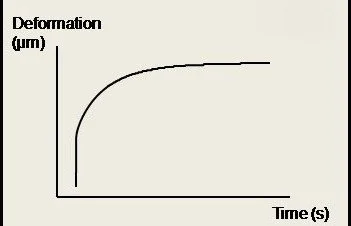
Tendon’s “Creep Curve.” Takeaway: Time is required for deformation/strain/stretch.
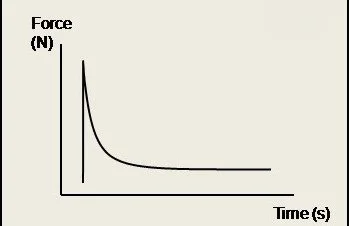
Tendon’s “Stress-Relaxation Curve.” Takeaway: Time decreases force distribution (i.e., stress).
The above two graphs depict how viscoelastic tendons experience both strain (deformation/stretch) and stress (force per unit of area) across different timespans. Taking these graphs together, forces applied to tendons in short durations are experienced with low strain/stretch and high stress, while forces applied at greater durations are experienced with high strain/stretch and decreased stress. Why is this the case? Due to their viscous nature, tendons initiate their transfer of force from the outside-in. Their outer layer initially handles the force while the centralized fibers of the tendon, which are heavily hydrated, are only able to assist with the load/stress after enough time has passed for the fluid to shift outside of the tendon’s extracellular matrix. It is only after this shift of fluid occurs that the entire tendon’s cross-sectional area can evenly redistribute and balance out the internal mechanical forces.
- - - - -
Now, we can begin to tie some of these loose ends together in a meaningful way. The bottom line is that sports are fast. In sports, sprints occur at maximal or near-maximal velocities, changes of direction are quick, ground contact times are short, and jumps/leaps/bounds are all expressions of high levels of power (force x velocity). The majority of actions involved in most sports typically bias the velocity side of the force-velocity curve. Beyond just high velocities (m/s), tendons are subjected to forces from high levels of accelerations (rate/change of velocity; m/s^2) and high levels of jerk (rate/change of acceleration; m/s^3) which are extremely short-duration exposures to high stress and have been shown to be mechanistically injurious. Based off our creep and stress relaxation curves above, we can easily explain how sports, in isolation, can create short, stiff, brittle, weak, and potentially damaged (from repetitive high, unbalanced stress) tendons. Great news—there is an antidote.
- - - - -
While sports epitomize high velocity and short windows of force production, the weight room constitutes the exact opposite where muscle-tendon units are exposed to higher forces, lower velocities, and longer duration contractions. Whereas sprinting and jumping have ground contact times down into mere milliseconds, a heavy and controlled tempo set of a traditional lift like a barbell back squat may take 30-45 seconds (orders of magnitude longer). This amount of exposure to high force is long enough for tendons to be stretched and wholly exposed to balanced stresses across the tendon’s full cross-sectional area. This means at least two things. First, tendons are exposed to force profiles in the weight room that create performance enhancing adaptations (e.g., thicker, denser, stronger). Secondly, this full-thickness exposure to force creates remodeling that is reparative/restorative, injury preventative, and balances out the potentially damaging nature of sports.
- - - - -
Lastly, we need to dispel a persistent misconception that is contradictory to the information established thus far. Very commonly, “tendon training” in the gym is mistakenly selecting exercises that employ the stretch-shortening cycle (SSC). The SSC is a three-phase muscular contraction that quickly shifts from eccentric (lengthening), amortization (transition), and concentric (shortening) phases. A muscle contraction that utilizes the SSC benefits from storing and releasing elastic energy stored in the tendon (not to mention the stretch reflex). This dynamic action constitutes the use of a tendon’s stiffness rather than losing this stored elastic energy to its own compliance/stretch (i.e., hysteresis). The typical practical application of the SSC is performing plyometrics/jumping exercises. However, when it comes to tendon development, plyometric-type exercises suffer from the same shortcomings as sports—they are far too quick for the entire tendon’s thickness to experience the force required to signal strength adaptations/improvements. It is for this same reason that these types of common “tendon training” (i.e., jumping) exercises fail to develop the most robust tendons possible.
- - - - -
In brief conclusion, tendons are unique tissues with specific developmental requirements. Playing sports in isolation will not only fail to best develop tendon strength but will also create injury susceptibility. Athletes (and their tendons) require intelligently designed strength training programs for off-season performance enhancement, in addition to in-season maintenance, restoration, and injury prevention. Lastly, don’t fall prey to the misconception that tendon training should be predominately plyometric/jumping exercises. These have the same high velocity, low ground contact, short contraction durations that sports do and will fail to develop a complete, resilient athlete.
- - - - -
Proudly written without A.I.